The principle of least privilege (PoLP) is a cybersecurity concept where users are granted only the minimum levels of access necessary to perform their job functions. By limiting access rights for users, accounts, and computing processes, organizations can significantly reduce the risk of data breaches and unauthorized activity in both apps and websites.
Implementing this strategy when it comes to your app security efforts effectively secures your data and systems without hindering productivity. It creates a safer environment where employees can do their best work without the accidental risk of compromising sensitive information.
TL;DR: what is the principle of least privilege?
The principle of least privilege is all about restricting access to the bare minimum. Think of it like a valet key for a car, it opens the door and starts the engine but it won’t open the trunk or glove box. This containment strategy limits the damage that can be done if an app is compromised.
| Feature | Description |
|---|---|
| Core concept | Limiting user access rights to the bare minimum needed for their role. |
| Primary goal | To reduce the attack surface and minimize the impact of a potential breach. |
| Key benefit | Improved security and stability of systems. |
| Common use case | Giving an employee read-only access to a file instead of edit access. |
What is the principle of least privilege?
The principle of least privilege dictates that a subject, which could be a user, a program, or a process, should only have access to the information and resources necessary for its legitimate purpose.
This principle applies to every layer of a system, from the end-user working on a laptop to the backend code communicating with a database.
This concept opposes the idea of "superusers" or "admin access for everyone," which was common in early IT environments for the sake of convenience. In a PoLP environment, a marketing manager has access to social media tools and content management systems but is restricted from accessing financial records or HR data.
This segregation ensures that if the marketing manager’s credentials are stolen, the attacker cannot easily pivot to steal payroll information.
Base44 exists to make building software feel as natural as explaining what you need.
— Maor Shlomo, CEO of Base44
Benefits of the principle of least privilege
Adopting this security model offers advantages that go beyond just locking down data. It creates a more robust and resilient infrastructure.
Better system stability
When access is restricted, the chances of a user accidentally changing a critical system configuration or deleting a vital file drop significantly. It acts as a safety net against human error.
Minimizes attack surface
If a bad actor gains access to a low-level account, PoLP prevents them from moving laterally across the network. They are stuck in a limited environment, making it much harder to cause widespread damage.
Easier audits and compliance
Many regulatory frameworks require organizations to limit access to sensitive data. Implementing least privilege makes it much simpler to prove compliance during an audit, as you have a clear trail of who has access to what.
Here's how to avoid common app security mistakes.
Common challenges of the principle of least privilege
While the concept is straightforward, putting it into practice can be tricky. It requires a delicate balance between security and convenience.
Privilege creep
Over time, employees often accumulate more access rights than they need. They might change roles or take on temporary projects, and their old permissions are rarely revoked. This gradual accumulation, known as "privilege creep," undermines the security model. If you manage staff records in your own tools, here's how to build an employee management app where access follows each person's role.
Frustration and productivity friction
If restrictions are too tight, employees may not be able to do their jobs effectively. This can lead to frustration and requests for "emergency access," which often results in granting permanent admin rights just to stop the complaints.
Complexity in management
Managing granular permissions for every single user and application in a large organization is a massive task. Without the right tools, IT teams can easily become overwhelmed by access requests.
Examples of the principle of least privilege
To better understand how this looks in the real world, let's look at a few common scenarios:
The standard user account
In a corporate environment, most employees should log in with a standard user account, not an administrator account. This allows them to run applications and browse the web but prevents them from installing new software or modifying system files.
Database access
A web application that retrieves product details for a customer only needs "read" access to the product database. It does not need "write" or "delete" permissions. If an attacker exploits the web app, they can't wipe the database because the application itself never had the power to do so.
One-time access
A developer needs to fix a bug on a production server. Instead of having permanent access, they are granted temporary, time-limited access to that specific server. Once the window closes, their access is automatically revoked.
![Image: A side-by-side comparison of an admin view vs. a standard user view]
How to get started with the principle of least privilege using Base44
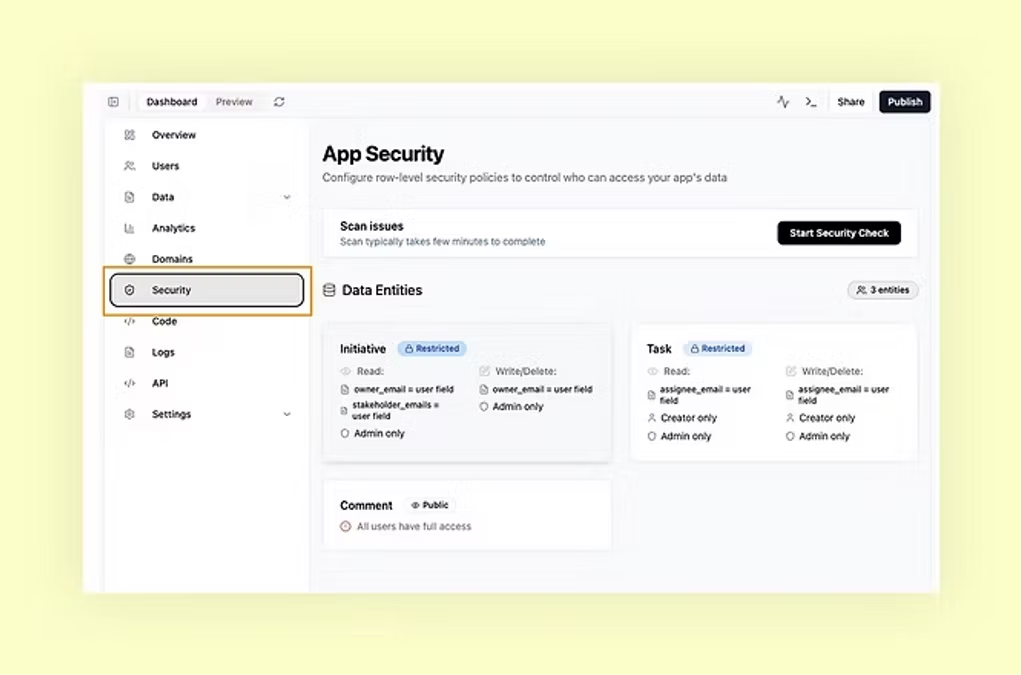
Adopting the principle of least privilege doesn’t have to mean months of manual audits or complex security tooling. With Base44, teams can design secure systems from day one—baking least-privilege access directly into how apps, workflows and AI agents are built. The same rule applies when you build an AI agent: connect only the tools and data its job needs. Base44 backend gives AI agents secure access to your app's data and logic. Base44 empowers entrepreneurs and teams to ship products fast.
Here’s how to apply least privilege effectively with Base44:
- Start with visibility into access
- Define access at the role level
- Limit elevated permissions by design
- Use time-bound and conditional access
- Continuously review and refine
01. Start with visibility into access
Base44 gives you a clear view of how users, workflows and AI agents interact with data and actions. Begin by identifying who can access which resources and which permissions are actually being used—so you can spot over-permissioned users or processes quickly.
02. Define access at the role level
Instead of assigning permissions one by one, Base44 lets you structure access around roles and functions. Whether it’s internal teams, external users or automated agents, permissions are tied to what each role needs to do—nothing more.
03. Limit elevated permissions by design
With Base44, privileged actions can be scoped to specific workflows or AI-driven tasks, rather than granted broadly. This means sensitive operations only run when triggered by approved conditions, reducing the risk of misuse or accidental exposure.
04. Use time-bound and conditional access
For workflows that require temporary elevated access, Base44 supports conditional logic and automation. Access can be granted only when needed—such as during an approval flow or system update—and removed automatically once the task is complete.
05. Continuously review and refine
Because Base44 centralizes logic, permissions and activity in one platform, it’s easier to review access regularly. As your app evolves or your team changes, you can update roles and permissions instantly, without rewriting code or disrupting users.
What is the principle of least privilege FAQ
Does least privilege mean zero trust?
Not exactly but they are related. Zero trust is a broader security framework that assumes no user or device is trustworthy by default, even if they are inside the network. The principle of least privilege is a core component of zero trust, focusing specifically on limiting what a trusted user can actually do.
Will removing admin rights break my applications?
It is possible. Some older (legacy) applications were built assuming the user has full administrative control. Before removing rights broadly, you should test your critical applications to ensure they function correctly under a standard user account. You may need to tweak specific folder permissions to make them work.
How do I handle developers who need to install tools?
This is a common friction point. Instead of giving developers blanket admin rights, you can use privilege management software. This allows you to "whitelist" specific approved applications that developers can install without needing full administrative control over the machine.