
Backend solutions, and backend as a service (BaaS) in particular, are the foundation of modern apps, and choosing the right one decides whether your team ships quickly or gets stuck managing servers. A BaaS removes the slow parts: provisioning, authentication, admin tools and the glue between them. Paired with an AI app builder, it takes you from idea to a working product without building the plumbing first.
Base44 is one example. The Base44 backend gives AI agents secure access to your app's data and logic, and it empowers entrepreneurs and teams to ship products fast. This guide covers what a backend includes, the benefits of a BaaS, how Base44 provides each piece and how to choose.
Explore how the Base44 backend works alongside an AI website builder to cover everything from infrastructure to frontend creation.
TL;DR
Backend as a service (BaaS) is a ready-made backend you connect to instead of building yourself. It gives your app a database, login, file storage, server-side functions and payments, so your team ships features while the provider runs the infrastructure.
What is backend as a service?
Backend as a service (BaaS)
Backend as a service is a hosted backend your app connects to through an SDK or API. It covers data, authentication, server-side logic, files and integrations, so you only write the parts that make your product different.
Without a BaaS, every project starts with the same work: set up a database, build login, write an API, store files, wire up payments and keep it all running. With a BaaS, those pieces already exist and scale for you.
One backend can also serve more than one frontend. The same data and logic can power a React web app, a browser extension and a mobile app, with fewer bugs and consistent behavior across all three.

What a backend includes
Every backend does the same five jobs, whether you build it or rent it. The table shows each one and the question it answers.
| Part | What it does | The question it answers |
|---|---|---|
| 01. Database | Stores and secures your data | Where does everything live? |
| 02. Login | Signs people up and checks who they are | Who is this user? |
| 03. File storage | Holds uploads such as images and PDFs | Where do files go? |
| 04. Functions and APIs | Runs server-side logic and exposes endpoints | What happens when someone clicks? |
| 05. Payments | Takes money and manages subscriptions | How do you get paid? |
Table 1.The five parts of a backend and what each one does.
01. Database
The database stores your records and decides who can see them. A good one also supports realtime updates, so your interface changes when the data does, and permissions that apply to single rows and fields, not only to whole tables.
02. Login and user management
Login covers sign-up, password resets, social sign-in and, for teams, single sign-on. Building it yourself is a common source of security mistakes, so most teams hand it to the backend.
3.73%
Of applications tested had broken access control, the #1 web application security risk.
03. File storage
Apps that accept images, documents or spreadsheets need somewhere to put them and a way to get a link back. File storage handles uploads so you don't run your own file servers.
04. Functions and APIs
Functions run code that shouldn't live in the browser: calls to protected third-party APIs, webhooks, scheduled jobs and custom endpoints. Secrets such as API keys stay on the server, and logs show you what ran and what failed.
05. Payments
Payments connect your app to a processor so you can sell products, run subscriptions and issue refunds without handling card data yourself.
Expert view
Base44 provided the perfect foundation to get Lunair up and running quickly. I needed to focus on the core AI video generation technology, not reinventing authentication, payments and database management.
Guy Manzur
Founder of Lunair
Benefits of backend as a service
The benefits of backend as a service come down to speed, focus and scale:
- Faster launches: ready-made infrastructure replaces weeks of setup.
- Lower maintenance: the provider handles servers, updates and scaling.
- Product focus: your team builds features and user experience, not plumbing.
- Built-in tooling: logs, secrets and admin views replace internal tools you would otherwise build.
- One backend, many frontends: web, mobile and extensions share the same data and logic.
- Consistent security: authentication and access rules live in one place.
Expert view
Base44 lets you focus on outcomes. Instead of asking, ‘How do I code this?’ you’re asking, ‘How does this make life better for my users?’ That’s where innovation starts.
Nina Boyd
Product Marketing Manager at Base44
Why a modern backend changes how teams work
A modern backend puts data, login, files, functions and payments in one system, so your team stops splitting its attention between infrastructure and product. Developers can add Base44 Skills to their AI coding assistant, build against the backend from their own IDE and run it locally before they deploy.
90%
Of developers now use AI in their daily workflow, up 14 points year over year.
2025 DORA report2025
That changes the daily workflow in three ways:
- Launch faster: new projects start from a ready backend structure instead of a blank repository.
- Stay consistent: every project uses the same authentication, data rules and deployment steps.
- Onboard sooner: new developers learn one backend instead of a different stack per project.
How Base44 provides each piece
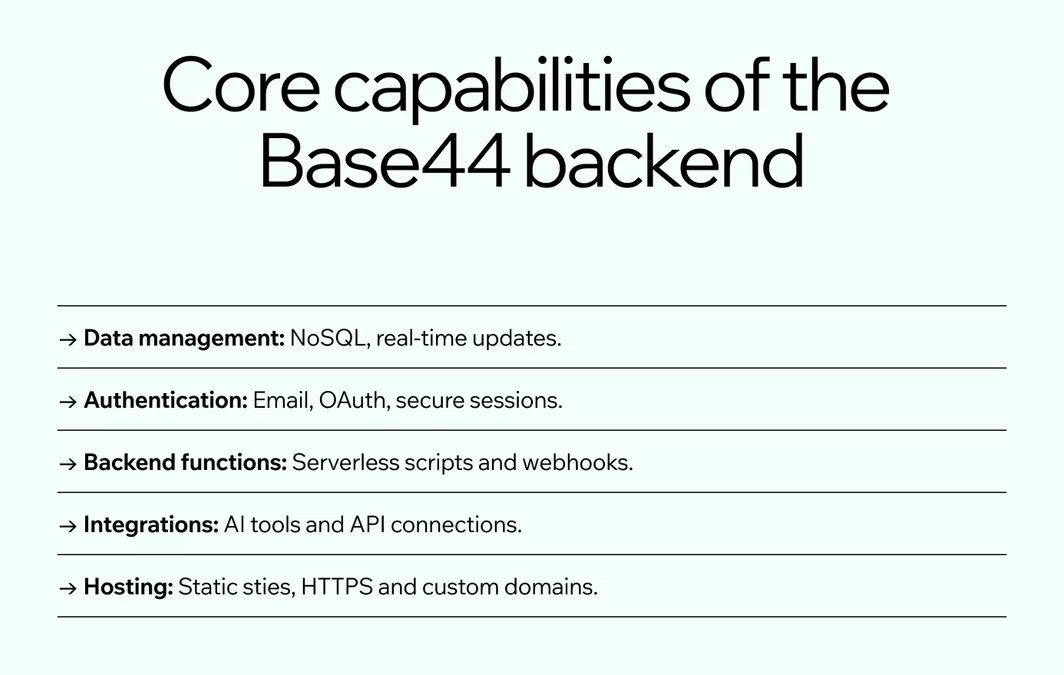
Base44 covers all five parts in one backend. The Base44 backend platform guide goes deeper on the architecture, and the Base44 features docs list everything it includes.
| Part | In Base44 | Learn more |
|---|---|---|
| 01. Database | NoSQL entities with row-level and field-level security and realtime updates | Base44 backend platform |
| 02. Login | Email and password, Google, Microsoft, Facebook, Apple and custom SSO | App security best practices |
| 03. File storage | The built-in UploadFile integration returns a file URL you can reuse | Built-in integrations |
| 04. Functions and APIs | Backend functions in TypeScript, called through the SDK or over HTTP | Base44 CLI |
| 05. Payments | Stripe, set up from the AI chat in a test environment first | Base44 Stripe integration |
Table 2.Where each backend part lives in Base44.
Base44 backend functions run on Deno, you deploy them with one CLI command and you read their output in the Logs page of your app dashboard. The Base44 CLI installs with npm install -g base44@latest and also creates projects, runs a local server and deploys your entities, functions and site. The CLI and backend are in beta.
Payments use Stripe and need the Builder plan or higher. You build and test with Stripe's test cards, then connect your Stripe account to go live. The Base44 Stripe integration docs walk through one-time payments, subscriptions and refunds.
Version control comes from the Base44 GitHub integration, which links your project to a repository for branches, pull requests and either a one-way export or 2-way sync. It also needs the Builder plan or higher. The backend service itself is free to use during beta, and its operations draw on the integration credits included in every Base44 plan.
Two guides show the backend in practice. Provision a full backend with Base44 and Stripe Projects covers launching the Base44 backend from the Stripe CLI, which is in developer preview. How Brik powered a complex frontend with the Base44 backend follows a team that finished its backend in two days instead of the two weeks it would otherwise take.
Expert view
In app building, speed and quality are often at odds. But with Base44, you don’t have to choose. It’s designed to help you build high-quality apps quickly, so you can get to market faster without cutting corners.
Nina Boyd
Product Marketing Manager at Base44
You can use the backend two ways. In the app editor, you describe your app and Base44 builds the frontend and the backend together. As a standalone backend service, you bring your own frontend and work from your IDE with the CLI and the JavaScript SDK. Combined with Base44 templates and Base44 Skills, either route gets you to a working product faster.
Connect the tools your app already depends on:
- Base44 Google Calendar integration
- Base44 Slack integration
- Base44 Google Drive
- Base44 Stripe integration
- Base44 GitHub integration
Backend as a service vs building your own
| Area | Build your own backend | Backend as a service |
|---|---|---|
| Setup time | Weeks | Minutes to days |
| Maintenance | Your team patches and scales servers | The provider runs infrastructure |
| Scalability | Manual | Built-in |
| Developer focus | Infrastructure-heavy | Product-focused |
| Tooling | Custom-built logs, admin and secrets | Out-of-the-box |
| Control | Full | Within the provider's limits |
Table 3.Building your own backend compared with using a BaaS.
Building your own makes sense when you need full control over every layer. For most products, a BaaS gets you to users sooner.
How to evaluate a backend as a service
When choosing a backend platform, focus on factors that affect long-term speed and scale:
- Developer experience: IDE support, local environments and high-quality SDKs.
- Operational tools: Built-in logging, secrets management and dashboards.
- Frontend support: SDKs and endpoints for the frontends you plan to ship.
- Compliance and governance: Audit trails and role-based access control.
- Extensibility: Custom logic and integrations when you need them.
The right platform should also support built-in integrations and custom domains, so you can go live without extra infrastructure. If you're planning a mobile product, see how to make a mobile app, and for security, read app security best practices and common app security mistakes.
Get started with the Base44 backend
With the Base44 backend, you create a project with the CLI and deploy it with a single command. New to building? Learn how to build an app with AI first.
Try the Base44 backend
Create your first backend project
Backend as a service FAQ
Backend solutions are the systems, tools and services that manage the server-side operations of an app. They handle data storage, authentication, business logic, files and integrations, so you can focus on features and user experience instead of infrastructure.
A BaaS reduces development time and operational overhead. You get ready-to-use infrastructure, built-in logs and a JavaScript SDK, so you can ship faster and keep workflows consistent across web, mobile and other frontends.
Not in the app editor, where you describe your app and Base44 builds the frontend and backend for you. The standalone backend service is for developers who bring their own frontend and use the CLI and SDK.
Yes, through Stripe. Payments are available on the Builder plan and above, and you set them up from the AI chat. Base44 installs Stripe in a test environment first, and live payments need a verified Stripe account.
The backend service is in beta and free to use, with no separate subscription. Its operations use the integration credits included in all Base44 plans, and you can upgrade your plan for higher limits.
Yes. The Base44 backend service works with your own frontend, including on platforms the app editor doesn't support, such as mobile. Your frontends call it through the JavaScript SDK or HTTP endpoints.