
Building an app is a great way to connect with your audience and open up new revenue streams. This guide walks you through the entire process, from your initial idea to launching and monetizing your creation.
We’ll cover the essential steps to bring your app to life. You’ll learn how to plan your app, choose the right AI app builder to create it and explore different strategies for making money from it. It’s all about turning your vision into a real, functional app that people will want to use.
Try Base44 today.
TL;DR: How to build an app and make money
Base44 is an AI-powered no-code platform that lets anyone build and ship production-ready apps without writing code.
Base44 closes the gap between having an idea and shipping a real product by removing every technical barrier in between.
Building an app for your business gives i a dedicated home on your customers' devices. To meet your goals, your app should include features that make life easier for your users, like booking services, shopping or accessing exclusive content.
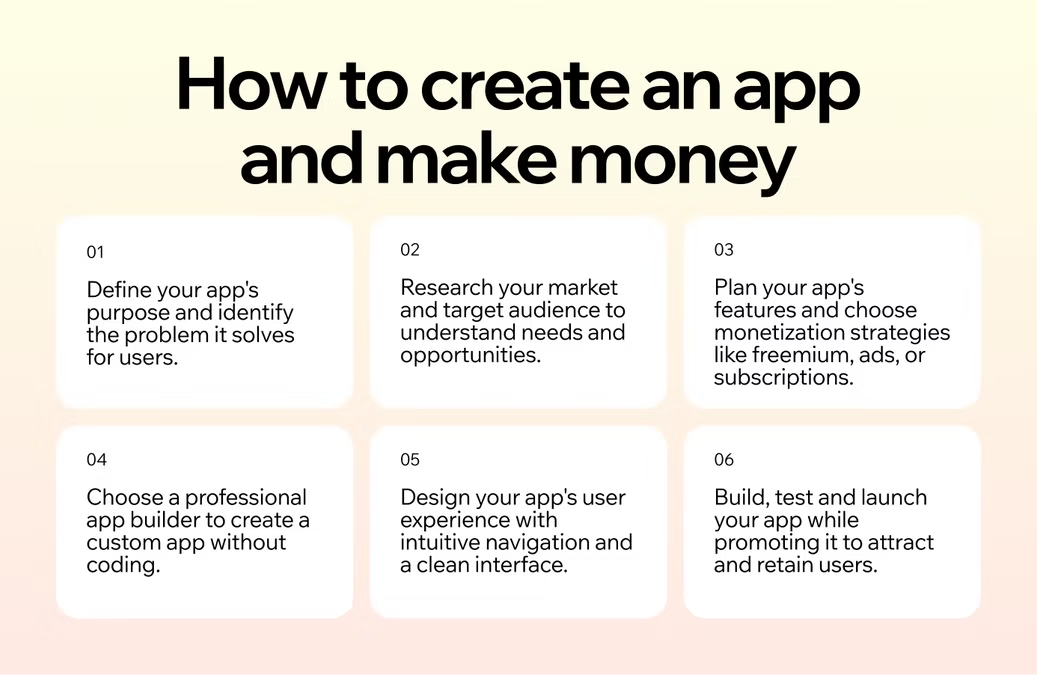
How to build an app and make money with it in 6 steps
Turning an idea into a profitable app is a straightforward process when you break it down. Following these steps will help you stay organized and focused as you move from one stage to the next.
- Define your app's purpose
- Research your market and audience
- Plan your app's features and monetization
- Choose a professional app builder
- Design your app's user experience
- Build and test your app
01. Define your app's purpose
Before you get into the weeds with your app design or development, you need a clear vision. What is the main goal of your app? Think about what you want to achieve. Are you looking to increase sales, improve customer loyalty or provide a unique service? Your purpose will guide every decision you make. especially if the aim of your app is to make money and not just improve a specific service for your users.
Next, consider the problem your app solves for your users. A successful app offers real value. It might save users time, entertain them or make a task simpler. Clearly identifying this problem and its solution will form the foundation of your entire project and make it much easier to market later. This process also helps you generate app ideas that users are more likely to pay for, giving your app a clear value proposition.
02. Research your market and audience
Understanding the landscape in which you plan to market and sell your app is crucial before you begin building an app with AI. Start by looking at other apps in your niche. What features do they offer? What do their user reviews say? This analysis will reveal what works well and where there are gaps you can fill. It’s not about copying competitors, but about learning from them to make your app better, including more valuable or affordable.
At the same time, get to know your target audience. Who are you building this app for? Create user personas that detail their demographics, behaviors and pain points. You can gather this information through surveys or by talking to potential users. Knowing your audience ensures you build something they’ll actually want to download and use and pay for.
Which app categories make the most money?
Not all app categories earn equally. If you're in the early stages of deciding what kind of app to build, it's worth knowing which categories consistently generate the highest revenue. Gaming apps dominate overall app store spending, largely because they're built for in-app purchases and can keep users engaged for years. Health and fitness apps do exceptionally well with subscriptions because users see ongoing value in tracking workouts, nutrition, and sleep. Education apps (think Duolingo or language learning tools) convert well to paid subscriptions when they deliver measurable progress. Productivity tools and B2B apps often have smaller audiences but higher willingness to pay, making them strong candidates for one-time fees or premium tiers. If you're building your first app, choosing a category with established monetization patterns makes your path to revenue more predictable.
03. Plan your app's features and monetization
With your purpose and audience defined, it's time to map out your app. List all the features you want to include, then prioritize them. Start with the "must-haves"—the core functions your app needs to work. You can always add the "nice-to-haves" later in updates. This keeps your initial build focused and manageable.
Now, think about how your app will make money. You could sell products, offer paid subscriptions for premium content, charge a one-time download fee or run in-app ads. Some apps use a "freemium" model, where the basic app is free but users can pay for advanced features. Choose a strategy that aligns with your app's purpose and what your users will find reasonable.
Most profitable apps rely on one or a combination of these three core strategies:
Freemium model
This is the most popular model uses in app development, Users download the app for free but you lock specific advanced features behind a paywall.
- Works best for: Productivity tools, photo editors and dating apps.
- How it works: Your app might let users edit photos for free but include a watermark that can only be removed if they pay. This is known as a gated featured. Or you might limit usage to free users, lets say on a dating app they get only 5 scans of available candidates a day but unlimited access will require paying for.
In-app advertising
If your app has a lot of users who don't want to pay, so the best idea is to monetize their attention. For example, users can choose to watch a 30-second ad in order to get a reward in the app. This is a popular method used in games. Another option is native ads, ads that look like regular content in your feed (common in social media or news apps). They're less intrusive and have higher click rates, while interstitials are full-screen ads that appear during natural breaks in app usage, such as between game levels.
Subscriptions
Subscriptions are a great way to monetize an app because they're stable and predictable income.
- Works best for: Content apps, think Netflix and fitness apps.
- How it works: Charge a smaller monthly fee over a larger one-time purchase.
In-app purchases
These can be things like consumables used in the game, virtual currency or game health packs as examples. Or it could be what's often referred to as non-consumables — paying to remove ads permanently or unlock specific levels.
Affiliate marketing
This involves promoting other businesses products inside your app. Lets say you have a travel app and you include in it affiliate links to buy suitcases from a suitcase seller and for every sale made through the link, you make a commission.
Sponsorship
If you have a specific niche audience (e.g., cyclists), a brand (e.g., a bike helmet company) might pay you to feature their logo or offer a branded challenge within your app.
Transaction fees
If your app connects buyers and sellers (like Uber or Etsy), you take a small percentage of every transaction that happens on your platform.
| Strategy | Best for | Pros | Cons |
|---|---|---|---|
| Freemium | Tools and utilities | Low barrier to entry; high download rates | Hard to convert free users to paid |
| Ads (IAA) | Games and social | Passive income; works with free users | Can annoy users; requires huge traffic |
| Subscription | Content and fitness | High Lifetime Value (LTV); stable income | High churn (cancellations); hard to sell upfront |
| Paid app | Pro Tools (B2B) | Immediate revenue per user | Very low download volumes |
Tips for monetization of an app
You can't monetize a user who uninstalls the app after one day. Focus on keeping users engaged before you aggressively push ads or paywalls. Monetization of an app is more of a long term effort.
The trend for app monetization in 2026 is mixed models. For example, offer a free app with ads but allow users to pay a subscription to remove them. This captures revenue from both paying and non-paying users. For a fuller list, here are 12 app monetization ideas and how to pick the right one.
You can't make money if no one finds your app. Optimize your title, keywords and screenshots to appear in search results.
How much money can an app make?
App revenue varies a lot depending on your monetization model, category, and user base, but the numbers can be encouraging. Apps with around 100,000 downloads can earn anywhere from $5,000 to $20,000 per month when they're monetized well.
Subscription-based apps tend to break even faster than other models, sometimes within 6 to 12 months, because the revenue is predictable and scales with your user base. Smaller apps just starting out with 1,000 downloads might bring in $10 to $50 per month from ads or one-time purchases, while medium-sized apps in the fitness or education space can earn $5,000 to $20,000 monthly through subscriptions.
The key takeaway is that profitable apps rarely rely on a single revenue stream. Most successful apps blend ads, subscriptions, and in-app purchases to keep revenue flowing without frustrating users.
Why retention matters more than downloads
Downloads are a vanity metric. The number that actually drives app revenue is retention which is how many users come back on day 2, day 7, and day 30. A user who installs your app and never returns can't be monetized, no matter how good your strategy is. That's why the most profitable apps invest heavily in onboarding from day one. A strong onboarding flow shows users the value of your app before asking them for anything. Push notifications, personalized recommendations, and regular updates all help keep users engaged over time. Aim for a day-7 retention rate above 20% as an early benchmark. If users are dropping off before that, revisit your onboarding before doubling down on any monetization strategy.
04. Choose a professional app builder
You don't need any coding or tech skills to build a professional app. AI app builders like Base44 let you describe what you want to build in plain language, and the AI takes care of the design, database, authentication, user permissions, and hosting automatically. There's a free plan to get started, with paid plans available as your app grows.
Learn more about how to use an AI app builder like Base44.
When choosing an app builder, look for one that offers flexibility and control. You'll want a solution that lets you design your app to match your brand and integrate the features you planned. For instance, an app builder can help you create a custom branded app without writing a single line of code, giving you a powerful tool to engage your community and grow your business.
Explore this roundup of the best ai app builders and best no code app builders.
05. Design your app's user experience
A good app is easy and enjoyable to use. The user interface (UI) is what your users see—the buttons, text and images. The user experience (UX) is how it feels to navigate through it all. Your goal is to make the journey from opening the app to accomplishing a task as smooth as possible.
Start by creating a simple wireframe or sketch of your app's layout. Think about how users will move from one screen to the next. Keep the design clean and uncluttered. Use colors and fonts that match your brand, and make sure all buttons and menus are intuitive. A strong design builds trust and keeps people coming back.
06. Build and test your app
Now for the exciting part: bringing it all together. Using the app builder you chose, you’ll start assembling your mobile app. Add your content, set up your features, and apply your designs. Follow the plan you created, building out the core functions first.
Thorough testing is a step you can't skip. Use the app yourself and ask friends or colleagues to try it. Click every button, test every feature and look for anything that’s confusing or broken. This feedback is invaluable for finding and fixing bugs before your app goes live, promising a positive experience for your first users.
How to publish and launch your app
Once you've built and tested your app, it's time to get it in front of users. If you're building on Base44, you can publish your app directly from your workspace, share it via a link, or connect a custom domain. For a broader reach, you can also submit your app to the Apple App Store or Google Play Store. The submission process requires you to create a developer account ($99/year for Apple, a one-time $25 fee for Google), prepare screenshots, write a description, and set your pricing. Base44 supports scanning and submitting your app to app stores directly from the platform, with submission file downloads available on Builder plans and above. Before you submit, make sure your app store listing is optimized: use keywords your target users would actually search for, write a compelling description, and include high-quality screenshots that show your app's core value in the first three frames.
You'll also need to market and promote your app because one without users, is also one that won't make any money. The main app monetization strategies need users.
How to market your app and get your first users
Building a great app is only half the battle. You won't make money if nobody finds it. Here's where to start:
App store optimization (ASO)
ASO is your baseline. Your app's title, keywords, and screenshots all affect where it shows up in search results. Think about what your target user types when they're looking for a solution to the problem your app solves, and work those terms into your listing.
Content marketing
Content marketing is one of the most scalable channels for early-stage apps. Write blog posts, short videos, or social media content that speaks directly to your target audience's problems. The goal isn't to go viral — it's to consistently show up where your users already spend time.
Community-led growth
Community-led growth works especially well in the beginning when you can't spend big on ads. Find forums, subreddits, Discord servers, or Facebook groups where your target users hang out. Participate genuinely, and mention your app when it's relevant.
Referral programs
Referral programs let your existing users do some of the acquisition work for you. If your app has a freemium or subscription model, offering users extra credits or a free month for referring a friend can drive significant organic growth.
Learn more:
- Wellness app development
- CRM app development
- How to make a food delivery app
- Entertainment app development
- Productivity app development
- Finance app development
Short-form video
Short-form video has become one of the most effective channels for launching apps, especially for consumer-facing products. TikTok, Instagram Reels, and YouTube Shorts let you show your app in action, which is far more compelling than a static ad. You don't need a big following to get reach: a single video showing a real problem your app solves can go viral with the right hook. Film screen recordings of your app, show the 'before and after' of using it, and post consistently for the first 30 days after launch. Apps that find a creator or two to post authentic use-case videos often see their first 1,000 users come entirely from this channel.
How to build an app and make money FAQ
The cost to build an app can vary widely. Hiring a development agency can cost tens of thousands of dollars. However, using a no-code app builder like Base44 is a much more affordable option, often available for a monthly subscription fee or you can build an app for free. These platforms give you the tools to create a professional app for a fraction of the cost of traditional development.
Free apps typically generate revenue through a few common strategies. Many use in-app advertising, where they get paid to show ads to their users. Others use a "freemium" model, offering a basic version for free and charging for premium features or content. Some also make money through in-app purchases, like selling digital goods or services.
It varies enormously based on your monetization model, niche, and marketing. A side-project app with a small engaged audience might bring in $500 to $2,000 a month through subscriptions or in-app purchases. Apps that hit product-market fit in a growing niche can scale to $10,000 or more monthly. The key isn't the app itself, it's distribution. The fastest-growing apps tend to invest heavily in community-led growth and content marketing before they optimize for revenue. Start with one monetization model, get your first 100 paying users, then layer in additional revenue streams once you understand what your audience values.
LTV:CAC compares how much a user is worth over time (lifetime value) against how much it costs to acquire them (customer acquisition cost). A commonly cited healthy target is 3:1 or higher, meaning each user brings in at least three times what it cost to bring them in. If your ratio is lower than that, it usually means you should focus on retention or your monetization model before spending more on ads or promotion.