Ready to see what Base44 can do for you? Get started →
If you run a small business or you're a creator looking to build something new, hearing AI development might sound intimidating. It summons images of massive server rooms and complex code that only a genius could decipher. But the reality is much more approachable. AI is simply a set of tools that makes software smarter, more helpful and incredibly efficient.
Artificial intelligence app development is the process of building applications that can perform tasks that usually require human intelligence. This includes things like understanding spoken words, recognizing objects in pictures and making decisions based on data.
In this guide, we’ll break down exactly how this works and explore the benefits of an AI app builder. Base44 no-code app builder makes app development accessible to any business or creator. Base44 no-code app builder replaces lines of code with conversational instructions.
TL;DR: The smart app cheat sheet
Here's a quick breakdown of what makes AI apps tick and why they are changing the game.
| Component | What it does | Real-world benefit |
|---|---|---|
| Machine Learning (ML) | Learns from data to improve over time without extra coding. | Netflix suggesting a movie you actually want to watch. |
| Natural Language Processing (NLP) | Helps computers understand and respond to human speech and text. | Chatbots that handle customer support instantly. |
| Computer vision | Allows apps to "see" and interpret images or video. | Banking apps that let you deposit a check by snapping a photo. |
| Predictive analytics | Uses history to guess what will happen next. | Inventory apps telling you when to restock before you run out. |
| Speech recognition | Converts spoken words into text or commands. | Dictating a text message while driving. |
The 5 core components of AI app development
Building an AI app is about about picking specific technologies—or components—that solve specific problems. Here are the main ingredients developers use to create intelligent apps.
- Machine Learning
- Natural Language Processing
- Computer vision
- Predictive analytics
- Speech recognition
01. Machine Learning: the brain
Machine Learning (ML) is the foundation of most AI apps. In traditional software, a human writes rules: "If the user clicks A, do B." In ML, the app looks at data and figures out the rules itself. The more data it processes, the smarter it gets.
Think of it like training a new employee. You don't program their brain; you show them examples of good work, and eventually, they figure out how to do it themselves.
Practical tip: You don't need to build an ML model from scratch. Many platforms offer pre-trained models. For example, if you want your app to filter out spam comments, you can plug in an existing ML tool rather than teaching a computer what spam looks like from day one.
02. Natural Language processing: the translator
Natural Language Processing, or NLP, bridges the gap between how humans speak (messy, slang-filled, emotional) and how computers understand things (zeros and ones). This technology allows apps to read text, understand the sentiment behind it and even write back.
This is what powers those helpful customer service chatbots on websites. Instead of forcing users to navigate complex menus, NLP lets them ask, "Where is my order?" and get a direct answer.
Use case: A local bakery could use an NLP-powered app to sort through hundreds of reviews, identifying common complaints (like dry muffins) or praise (great coffee) so the owner knows exactly what to fix.
03. Computer vision: the eyes
Computer vision gives apps the ability to see and interpret visual information. It’s not just about taking a picture, it’s about understanding what is in that picture.
Today this tech is everywhere. It’s how social media apps suggest tags for your friends in photos, its how you unlock your phone with your face. For businesses, this opens up incredible possibilities.
Example: A fashion retailer could build an app where users snap a photo of a stranger's outfit on the street and the app instantly finds similar items in the store's inventory. It turns the entire world into a catalog.
04. Predictive analytics: the fortune teller
Predictive analytics uses historical data to forecast future outcomes. By analyzing patterns in what happened yesterday, the AI makes a highly educated guess about what will happen tomorrow. This is huge for efficiency because instead of reacting to problems, you can solve them before they happen.
Practical tip: If you manage a subscription box service, predictive analytics can flag customers who are likely to cancel based on their recent activity (or inactivity). This gives you a chance to send them a special offer to keep them around before they actually hit the unsubscribe button.
05. Speech recognition: the listener
This component converts spoken language into text. It allows for hands-free control and makes apps more accessible to people who struggle with typing or small screens.
It’s often paired with NLP. Speech recognition turns the audio into text and NLP figures out what that text actually means.
Use case: A note-taking app for creative professionals that records brainstorming sessions and automatically transcribes them into searchable text, distinguishing between different speakers.
Why build an AI app?
So, why go through the trouble, why not just stick to standard apps? Because adding artificial intelligence to your software creates a better experience for your users and saves you large amounts of time.
It encourages engagement through personalization
Generic experiences are boring, we all want to feel like an app was made just for us. AI analyzes user behavior to tailor content, product recommendations and interfaces to individual tastes. When an app gets you, you tend to stick around longer on an app.
It handles the busy work
Automation is great but intelligent automation is even better. Standard automation follows a rigid path but AI automation can handle variations. It can sort support tickets, categorize expenses or schedule meetings without human input, freeing you up to focus on the big picture.
It speeds up decision-making
Data is useless if you can't understand it. AI apps can crunch through millions of data points in seconds to give you actionable insights. Instead of spending hours in a spreadsheet trying to figure out which product is selling best in which region, an AI dashboard just tells you.
Challenges to keep in mind
AI app development isn't without tradeoffs. Poorly trained models can reflect bias in the data they learned from, so it's worth testing how your app behaves across different types of users. AI features can also add real infrastructure and API costs as usage scales, and integrating multiple AI components together takes more planning than a single feature. None of this should stop you from building, it just means testing broadly and starting small before you scale up.
How to get started with AI app development
AI app development is now more accessible and affordable than ever before, thanks to the development and growth of AI app builders. You can even build an app for free, if you choose from one of these best free AI app builders.
The no-code app development revolution
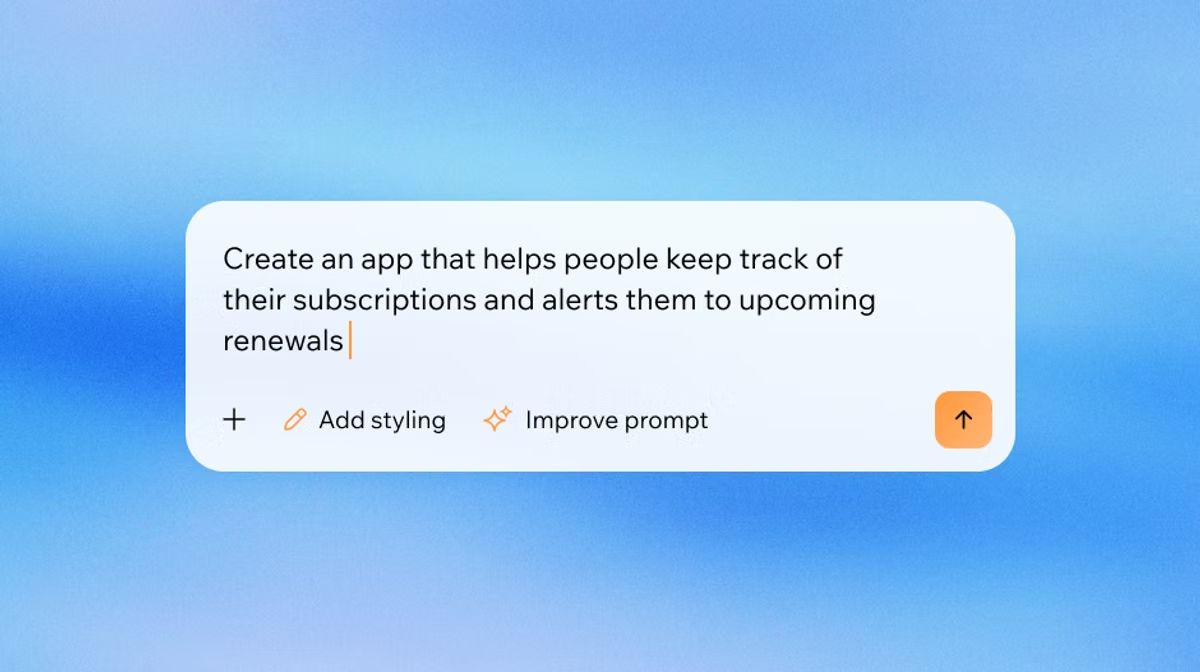
AI app builders like Base44 now allow you to integrate AI features without writing code. You can build an app with AI simply by chatting with it in natural language via chat interface. This essentially democratizes app building tech, putting the power of AI into the hands of creators and SMBs who have great ideas but small budgets.
Base44 exists to make building software feel as natural as explaining what you need.
— Maor Shlomo, CEO of Base44
Using APIs
If you have a development team, they don't need to invent new AI. They can use APIs (Application Programming Interfaces) from major tech companies. Essentially, you rent the brain power of a supercomputer and plug it into your app. This makes app development of all kinds faster and cheaper.
What is AI app development? FAQ
Do I need a huge budget to build an AI app?
While building a proprietary AI model from scratch is expensive, most businesses use pre-built AI tools and APIs. Also, no-code app builders allow you to create AI-powered apps for a fraction of the cost of traditional development.
Is AI app development only for large tech companies?
Not anymore and small businesses actually benefit the most from AI because it acts like a force multiplier. It allows a small team to handle the workload of a much larger one by automating customer support, marketing analysis and data entry.
How long does it take to build an AI app?
It really depends on the complexity. With AI app builders, you could have a simple AI-powered prototype running in a few days. A fully custom, complex application built with traditional coding might take several months.
Is my data safe with building with AI?
Security is a priority in AI development. However, you must be careful about how you use user data to train your AI. Always use reputable AI app builders, like Base44, check you have user consent and be transparent about how data is used. Trust is your most valuable asset.
Does AI replace developers entirely?
No. AI can generate code, suggest designs and automate a lot of the busywork, but human judgment still matters for strategy, business logic and making sure the app actually solves the right problem. Think of AI as a powerful assistant, not a replacement for your vision.