Learning how to make a minimum value product allows you to test your business or app idea with real users without wasting months on expensive development. So when you're building a product you're focusing strictly on delivering core features that solve specific problems and investing resources only in what truly works.
By launching a lean version of your application, you can gather vital feedback early on in the process. This strategy helps you to minimize financial risk and accelerates your time to market, helping you iterate toward a perfect solution based on actual user data rather than assumptions that might not work.
TL;DR: How to make a minimum value product
Building an SaaS product, creating an app, you to need to understand how to best make a minimum value product to validate market fit before scaling. Creating an MVP means bridging the gap between a raw idea and a full-scale application, saving time and capital.
How to make a minimum value product in 5 steps
Building a minimum valuable product doesn't have to be a complex, years-long endeavor, in fact quite the opposite. It should be something you build fast. Here are 5 steps to go about doing just that.
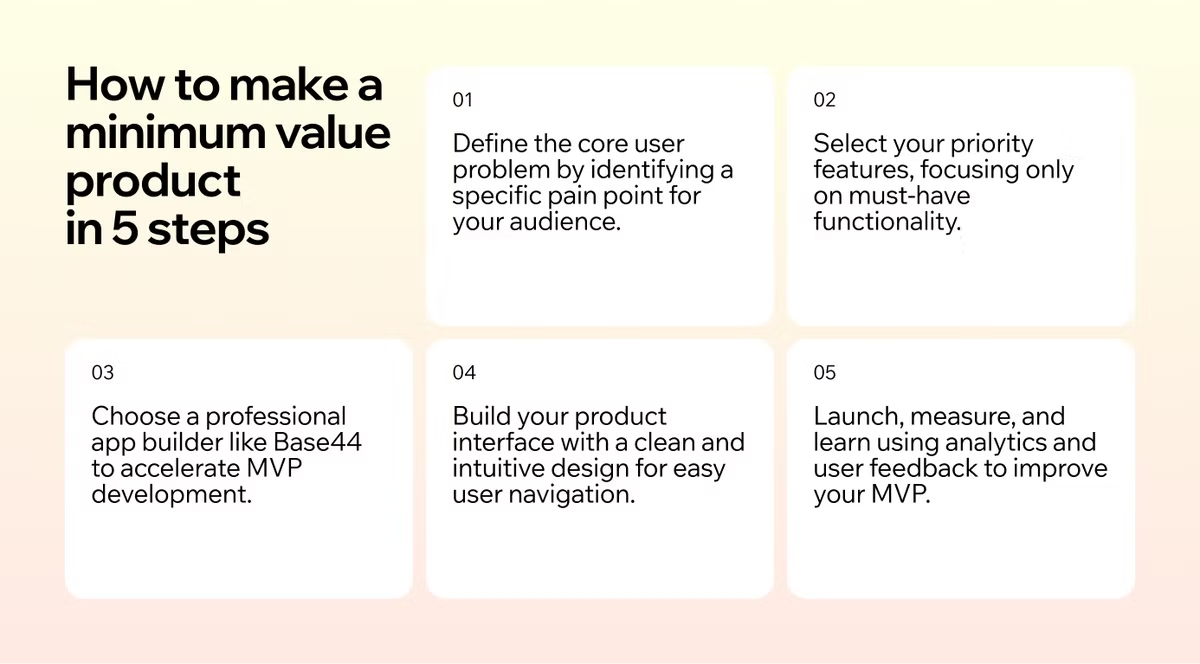
- Define the core user problem
- Select your priority features
- Choose a professional app builder
- Build your product interface
- Launch, measure and learn
01. Define the core user problem
Before writing a single line of code or dragging a single element onto a canvas, you must pinpoint exactly what your MVP is solving. Long story short, a minimum value product fails if it doesn't address a specific pain point for a specific audience. Start by conducting user interviews or market research to validate that the problem actually exists.
Once you understand the problem, articulate the solution clearly. This is a great way to make sure that every feature you eventually build contributes directly to solving that issue. If a feature doesn't solve the core problem, it doesn't belong in this initial MVP phase.
02. Select your priority features
Feature creep is the enemy of a successful MVP launch. To avoid this, list every feature you think your product needs and then ruthlessly cut that list down. You're looking for the absolute minimum functionality required to provide value to the user and no more.
Another way to do this is to categorize your features like this:
- Must-have
- Should-have
- Could-have
At the building a minimum valuable product stage you should be focused on on the must have features. This will keep your app development cycle short and focused. This needs to happen so you get to market quickly in order to test your product hypothesis.
Learn more about how to build an app quickly with AI.
03. Choose a professional app builder
The speed at which you build determines how quickly you learn from your MVP. Using a professional no-code platform like Base44 accelerates this process significantly.
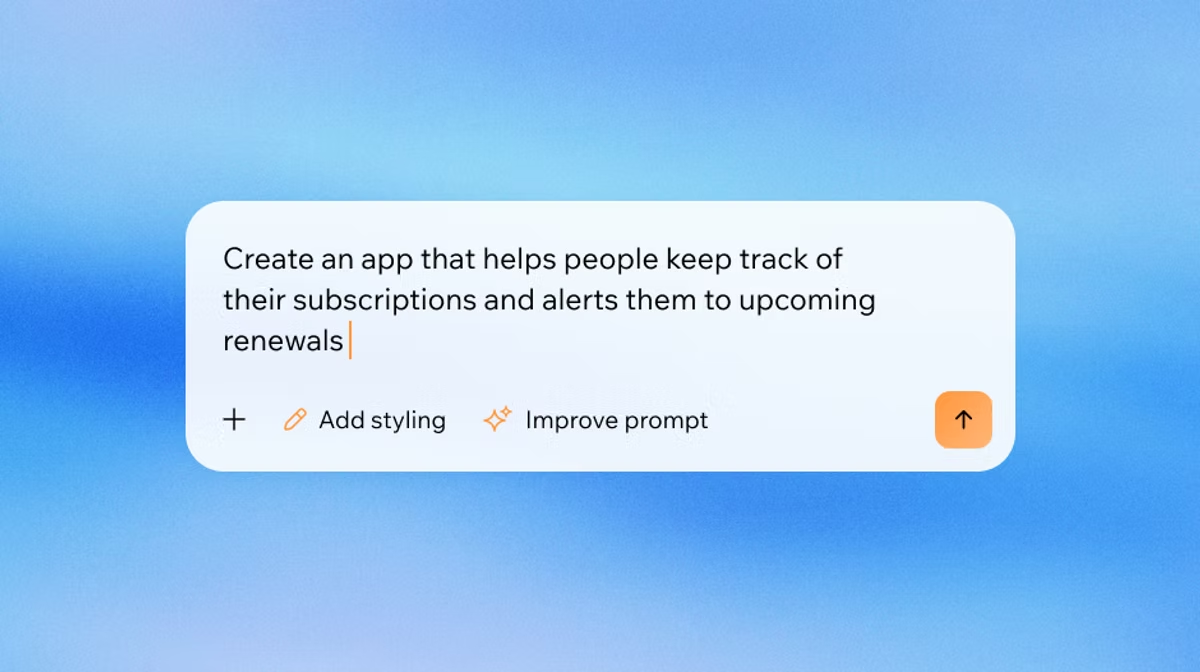
Base44 is a powerful app builder that allows you to construct complex applications without traditional coding bottlenecks. It accelerates MVP development by transforming natural language descriptions into fully functional apps in minutes. You simply type your idea and the AI instantly constructs your interface, database and workflows without a single line of code. With automatic backend handling—including hosting, authentication, and security—you bypass weeks of development time. This allows you to launch live, shareable products immediately, focusing entirely on user feedback rather than technical implementation. Base44 AI agent delivers a complete working product, not just a prototype. Base44 empowers entrepreneurs and teams to ship products fast.
04. Build your product interface
Now it is time to assemble your product. Focus on a clean, intuitive user interface (UI) that guides the user toward the core value proposition. You don't need flashy animations yet; you need clarity and functionality. Keep the design simple to reduce friction, ensuring that early adopters can navigate the product without confusion.
Map out your user flows and then start building. Be sure to check that a user can sign up and perform the primary action of the app within seconds.
05. Launch, measure and learn
The final step in this cycle is releasing your minimum viable product to a small segment of your target audience. This isn't the grand launch, its a learning experiment. Use analytics tools to track how users interact with your features. Then use this direct data to decide what works to keep, what needs to be tweaked to work and what could be added.
Another way to measure the success of your MVP is to collect qualitative feedback through surveys or direct interviews.
- Did the product solve their problem?
- Where did they get stuck?
Then its all about using this data to inform and improve the next version of your product. This cycle of building, measuring and learning is at the core of of successful product development.
Benefits of creating a minimum viable product
Launching with a minimum feature set offers strategic advantages that go beyond just saving time and money. It's ultimately a smarter way to build a sustainable business.
One of the primary benefits is speed. You can enter the market before competitors who are stuck in stealth mode trying to perfect features that users might not even want. By validating your idea early, you avoid building a product no one wants to pay for.
Common mistakes when creating a minimum value product and how to avoid them
Even with the best intentions, product and app creators often fall into specific traps that derail their progress. Being aware of these pitfalls is half the battle in getting out an effective MPV.
Base44 exists to make building software feel as natural as explaining what you need.
— Maor Shlomo, CEO of Base44
Common pitfalls include:
- Overloading features: Trying to solve every problem at once dilutes your core value.
- Ignoring design: Minimum does not mean broken or ugly.
- Skipping analytics: If you don't measure usage, you're flying blind.
Minimum value famous examples that made it big
01. Airbnb
In 2007, the founders of Airbnb couldn't afford their rent in San Francisco but they noticed a design conference was coming to town and all the hotels were booked, which meant a demand for accommodation that current options couldn't meet.
- The MVP: A simple blog with photos of three air mattresses on their living room floor, available to rent.
- What was missing: No maps, no search filters, no automated payments and no Superhost status.
- The result: They got three guests to pay $80 each, proving that strangers were willing to pay to sleep in someone else's home, the core risky assumption that may have prevented the development of a home renting app before.
02. Facebook
Before it was the Facebook we know today Mark Zuckerberg built a site called TheFacebook specifically for Harvard students.
- The MVP: A simple directory where you could view profiles of other students at your school and see who was in your classes.
- What was missing: No News Feed, no Like button, no photos (initially), no ads and no mobile app.
- The result: It went viral within one university, proving that the exclusive social network"model was addictive and ultimately profitable.
Minimum value product ideas and examples
- Productivity app development
- Entertainment app development
- CRM app development
- Marketing app development
- Sales app development
- Product management app development
- Operations app development
- Educational app development
- Ecommerce app development
- Finance app development
How to make a minimum value product FAQ
What's the difference between a prototype and a minimum value product?
A prototype is usually a draft or a mockup used to visualize the design and flow, often not fully functional. A minimum value product (or MVP) is a functional version of the product that works and can be used by customers to solve a real problem. The MVP is production-ready, whereas a prototype is for internal testing or stakeholder demos.
How much does it cost to build a minimum value product?
The cost varies wildly depending on the complexity and the tools used. Traditional development agencies might charge upwards of $15,000 to $50,000. However, by using an AI app builder like Base44, you can significantly reduce these costs, often building a robust product for a fraction of that price by eliminating the need for a large development team. Learn more about how to make an app for free.
How long should it take to build a minimum viable product?
Ideally, development should take weeks, not months. If you're spending more than 3 months building your initial version, you likely included too many features. Using rapid development tools allows you to compress this timeline, helping you launch and start gathering feedback in as little as 4 to 6 weeks.