Launch your app faster with Base44. Start now →
The biggest vibe coding trends of the past year aren't about hype, they're about what actually shipped. Vibe coding, the practice of building apps by describing what you want in plain language and letting AI generate the code, has moved past the "early adopter" phase.
Base44 is built around this shift: Base44 vibe coding lets users build apps by describing what they want conversationally, turning natural language into fully functional application code without syntax, frameworks or a development team.
What changed is not just the tools, it's the people building, the expectations for speed and the standards for what counts as production-ready. The ten trends below are drawn from SERP analysis, developer community data and real patterns emerging across the vibe coding landscape. Each one signals where the practice is going next. Read about what vibe coding is before diving into where it's headed.
TL;DR: vibe coding trends
Ten clear patterns are defining how vibe coding evolves. Here is the short version.
| Trend | What it signals |
|---|---|
| 01. Autonomous agents | AI scaffolds, tests and deploys, not just suggests |
| 02. Prompt-to-app speed | Complete apps from a single conversation |
| 03. Payments baked in | Authentication, payments and hosting are standard features |
| 04. Developer role shift | Architects and prompt engineers, not syntax writers |
| 05. Structured prompting | Context files and PRDs before every session |
| 06. Security guardrails | Review layers emerge after early failures |
| 07. Build-in-public learning | Real-time tutorials drive mass adoption |
| 08. Non-technical majority | 63% of vibe coding users aren't developers |
| 09. Backlash as maturation | Criticism signals the field is getting serious |
| 10. Market expansion | $4.7B market in 2026, projected $12.3B by 2027 |
10 vibe coding trends to watch
- Autonomous agents
- Prompt-to-app speed
- Payments backed in
- Developer role shift
- Structured prompting
- Security guardrails
- Built-in-public learning
- Non-technical majority
- Backlash as maturation
- Market expansion
01. From autocomplete to autonomous agents
The clearest shift in vibe coding is what AI actually does during a build session. Early AI coding tools worked as intelligent autocomplete: they suggested the next line, completed a function or filled in boilerplate. The new generation of AI agents goes further, executing multi-step workflows with limited human input.
A developer can now give a single instruction: scaffold a REST API, write tests and push to Git and an agentic tool will execute each step in sequence. According to research published on arXiv, these agents can complete full development tasks with minimal human intervention, compressing timelines from hours to minutes.
This changes what vibe coding actually requires from you. Your job shifts from managing syntax to defining clear intent. Understanding how vibe coding works at this agentic level is the foundation for getting the most out of these tools.
02. Prompt-to-app in minutes
Complete working apps from a structured prompt. That is no longer a marketing claim, it is what non-technical founders and product managers are shipping every week. The compression of early-stage development timelines is one of the most documented effects of vibe coding at scale.
According to a JetBrains AI Pulse Survey, 74% of developers report increased productivity when using AI-assisted development approaches. The gains are most pronounced at the idea-to-MVP stage, where traditional development required weeks of setup before any visible output.
"We launched it within a week. Just before Gift My Book, we worked with developers and it took a few months, and then we basically built it in a week." — Yoav Hornung, co-founder, Gift My Book
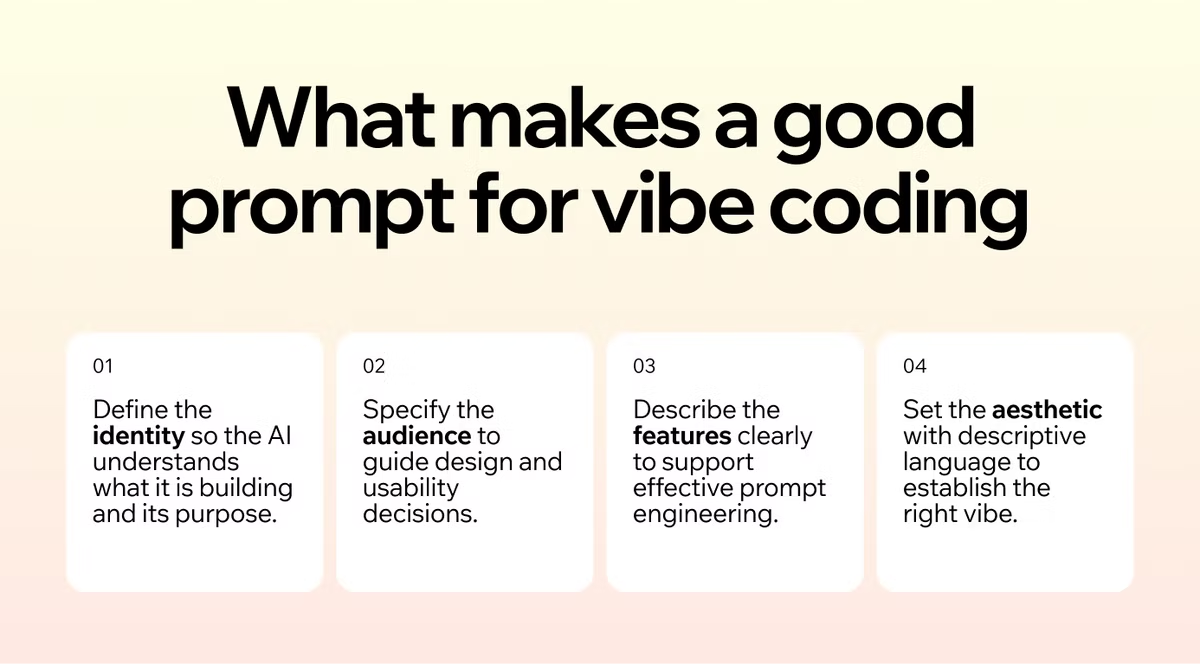
Base44 turns a conversation into a fully built app, backend infrastructure, logic and UI, without configuration steps or a dev team. The result is a working product, not a prototype. For the prompts that get you there faster, see this guide to prompts for vibe coding.
Learn more:
- How to write AI prompts
- Best AI prompts to build a website
- Prompts for vibe coding
- Best prompts for app building
03. Payments, authentication and hosting baked in
A year ago, connecting payments or setting up authentication in a vibe-coded app still required manual configuration. That is no longer the norm. Platforms across the vibe coding space now bundle authentication, payments and deployment directly into the generated app, reducing the setup gap between a prompt and a shipped product.
This is a meaningful step forward for non-technical builders who previously hit a wall once the UI was done. The tradeoff is real: tighter integration with a platform's ecosystem increases dependency. Builders need to evaluate which capabilities they need baked in versus which they may need to own independently as the product grows.
"Base44 provided the perfect foundation to get Lunair up and running quickly. I needed to focus on the core AI video generation technology, not reinventing authentication, payments and database management." — Guy Manzur, solo founder, Lunair
04. Developer roles shift from syntax writers to architects
The developer job description is being rewritten. Prompt engineering, the ability to communicate intent precisely and iteratively to an AI system, is now listed as a required skill in hundreds of job postings on freelance platforms. According to data cited in a Business Insider report, AI-assisted development roles on platforms like Upwork grew by over 650% between late 2023 and early 2025.
The frame shift is from "how do I write this function" to "what does this product need to do." Developers who excel in this environment aren't syntax experts, they're system designers who know how to give AI enough context to generate the right output.
This is where the debate around vibe coding vs traditional coding matters most: the two approaches do not replace each other, but they require very different skill profiles.
"Speed to market is everything in today's app economy. Base44 allows you to prototype, test and launch faster than traditional development methods, giving you a competitive edge without sacrificing quality." — Nina Boyd, PMM at Base44
05. Structured prompting and context files become standard
The most experienced vibe coders do not start a session by typing a vague prompt. They provide structure first: a PRD summary, a repository context file, a defined set of constraints. This practice, sometimes called "context priming," has become standard on teams that ship frequently with AI.
The reason is practical. AI systems generate better output when the context is explicit. Structured inputs reduce hallucinated architecture, keep sessions aligned with the product brief and make it easier to hand off sessions between team members.
This practice is closely tied to the quality of your prompts.
06. Security guardrails emerge after early failures
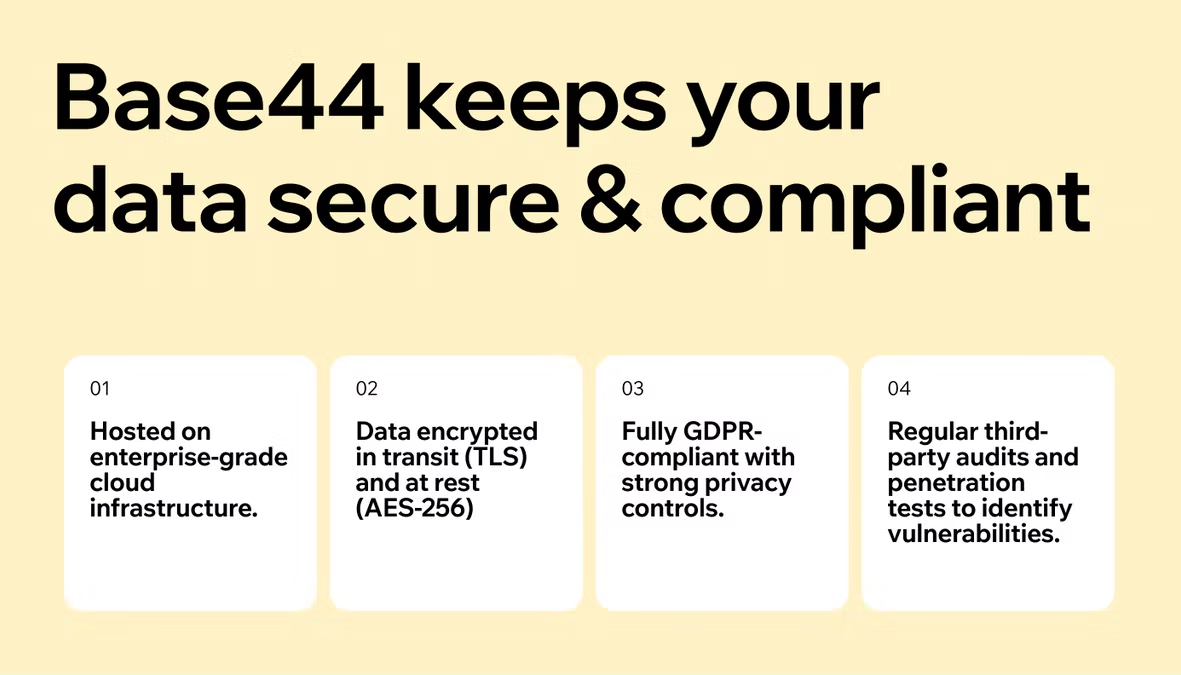
Speed without review creates risk. Early adopters discovered this the hard way. A 2025 security study found that 10.3% of AI-generated apps analyzed had critical row-level security flaws in their database configurations: real apps, handling real user data, with exploitable access gaps (Taskade State of Vibe Coding report).
The response from the community has been practical: mandatory code review layers, automated testing pipelines, sandboxed environments for AI-generated code and security scanning before deployment. These aren't anti-vibe-coding positions, they're the natural maturation of any development practice that moves fast.
Knowing where vibe coding commonly goes wrong makes you a more effective builder. Common vibe coding mistakes covers the patterns that lead to brittle deployments and how to avoid them.
07. Build-in-public tutorials drive community learning
One of the most effective drivers of vibe coding adoption has been transparency. Developers and founders share real-time app-building sessions on YouTube, X and Substack, full sessions showing the prompts, the failures, the iterations and the final shipped product.
This build-in-public culture has two effects: it lowers the barrier for new builders by showing what the process actually looks like and it surfaces best practices faster than documentation or formal courses ever could. The community has become the curriculum.
Vibe coding tool searches grew by over 6,700% in the months following the initial wave of build-in-public content (Exploding Topics). That number reflects how much visibility community-driven content can generate for a technical practice.
Explore: free vibe coding
08. Non-technical builders become the majority
This trend may be the most significant one on this list. According to the Taskade State of Vibe Coding report, 63% of vibe coding users aren't developers. Entrepreneurs, product managers and small business owners are now shipping apps without a single engineer on the team.
"I got really good at finding the pain points of businesses, but I never knew how to actually implement it into a product and Base44 really gave me that place to do it without having to know any sort of code." — Amit Swissa, founder, Stela360
Base44 gives solo entrepreneurs a full engineering team in one tool, backend infrastructure, logic, UI and deployment, handled by AI so builders can focus on the product vision. This is the core promise of vibe coding: the technical stack stops being the ceiling.
If you are new to building with AI, how to get started with vibe coding walks through the first steps in plain language, with no assumed technical background.
Sarah signed up, wrote a prompt and had a fully functioning first version of her YouTube SEO review tool ready in under five minutes:
"I'm not a project manager, I don't know how to code, but I do know how to define a pain point. And I found a solution with Base44. Base44 is a tool to build tools for people like me who don't have a technical background." — Sarah Adam, Influencer Marketing Manager at Wix, Base44 user
09. The backlash and what it actually signals
Backlash is part of the vibe coding story. Critics have pointed to brittle deployments, hallucinated logic, apps that look complete but break under real user load and overconfidence in AI-generated output. A Stanford RCT found that developers using AI coding tools wrote less secure code than those who did not, while simultaneously reporting higher confidence in its security (ACM Digital Library).
The criticism is valid. But criticism is also the signal that a practice is being taken seriously enough to stress-test. The vibe coding community is responding with the same tools any maturing development practice develops: review protocols, security layers, testing standards and clearer frameworks for when vibe coding is the right approach and when it isn't
Understanding the honest tradeoffs is useful. Why vibe coding gets a bad rap covers the main criticisms and the context that makes them more accurate and less alarming, than they first appear.
Explore: vibe coding examples
10. Market growth and where vibe coding is headed
The vibe coding market is estimated at $4.7 billion in 2026, with projections reaching $12.3 billion by 2027, according to the Taskade State of Vibe Coding report. Collins Dictionary named vibe coding its Word of the Year for 2025. According to Second Talent, 87% of Fortune 500 companies have adopted at least one vibe coding platform.
"Whenever I was working with a development firm for 2 years, I spent over $125,000 trying to build that. And now for $400 a month, I can build a better product that is more appealing to customers and it's an actual painkiller instead of a vitamin." — Zak, solo founder, Grapevine Workplace
The trajectory points toward AI handling full development workflows, requirements gathering, coding, testing, deployment and monitoring, while human builders focus on architecture, product vision and the decisions that require judgment. Development platforms are converging around unified interfaces that blend natural language prompts, visual editing and traditional coding access in one environment.
Base44 AI app builder removes the gap between imagining and shipping an app, and as the vibe coding market matures, that capability becomes the standard expectation, not the exception.
Vibe coding trends FAQ
What are the biggest vibe coding trends right now?
The most significant current trends are the shift from autocomplete tools to autonomous agents, the rise of non-technical builders as the majority user group and the emergence of structured security practices after early deployments exposed vulnerabilities. Prompt-to-app speed and payments baked into platforms are also defining the current wave.
Is vibe coding replacing traditional software development?
Not replacing, reshaping. Traditional development skills remain relevant for complex infrastructure, security-critical systems and highly customized products. What vibe coding changes is the entry point: it lets non-technical builders ship real products and lets experienced developers move significantly faster at the prototyping and MVP stage.
What tools are driving the latest vibe coding trends?
AI app builders like Base44, which generate full-stack apps from natural language prompts, are central to the current wave. The broader ecosystem includes agentic coding environments, CLI-based AI agents and platforms that bundle deployment infrastructure alongside the generation layer. The common thread is the shift from suggestion-based tools to ones that execute multi-step workflows autonomously.